Things to check
Checked against Inkling on , 2 min read
Open in InklingOn this page5 headings
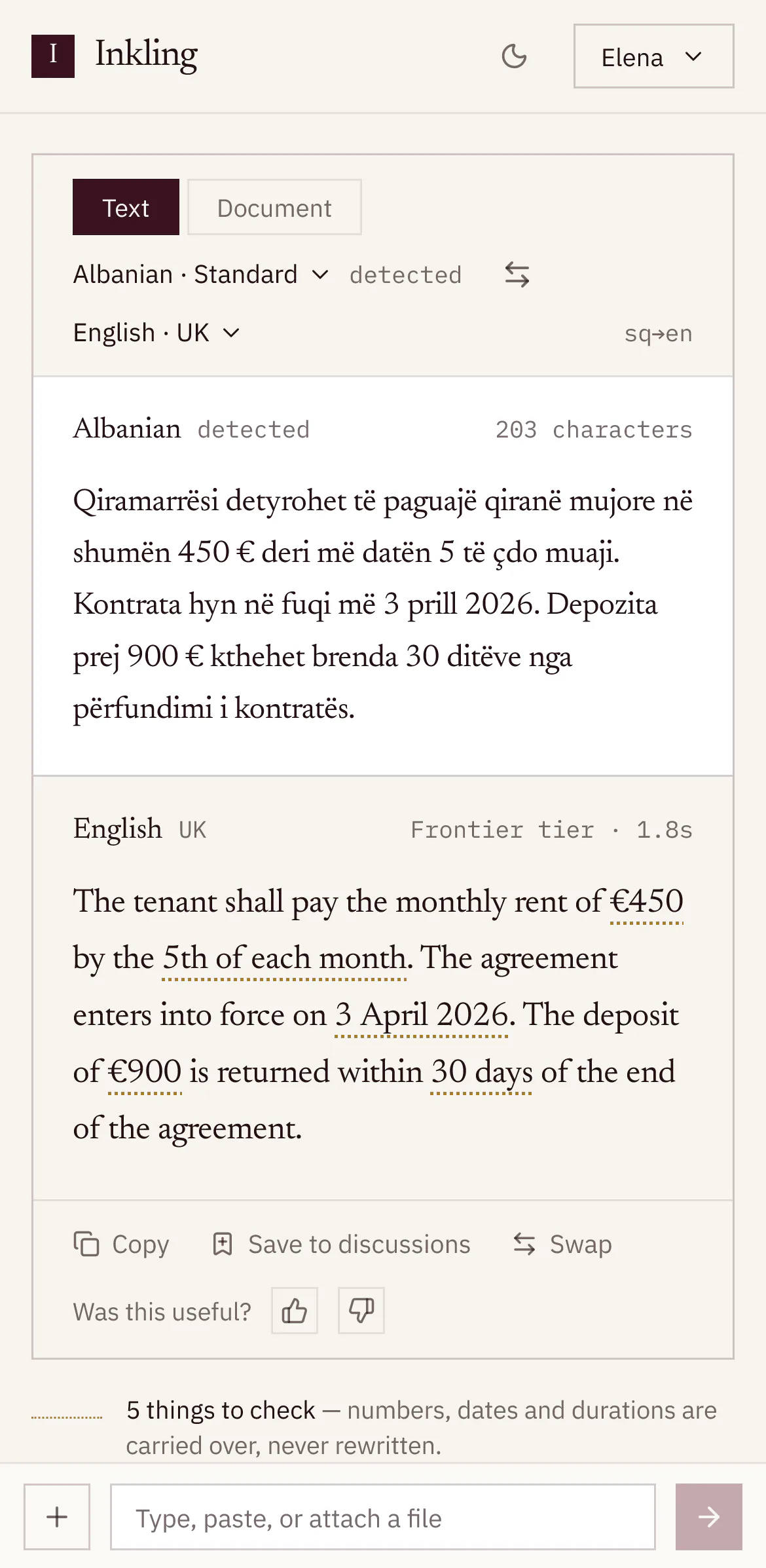
Inkling underlines the numbers, amounts, dates, durations and names it carried across into a translation, so you know which parts to verify against the original.
Before you start
Checks are part of every text translation, on every plan. There is nothing to switch on. In a translated document the same checks are listed page by page under Check these; see Review and download a translated document.
What gets marked
Inkling is told to carry these over exactly as they are written, never to convert or rewrite them, and to mark each one it carried:
| Kind | For example |
|---|---|
| Number | 12, 1,000.50 |
| Amount | €450, 900 EUR |
| Date | 3 April 2026, 03.04.2026 |
| Duration | 30 days |
| Name | a person’s or a company’s name |
A price stays in its own currency, and a date keeps its own numbers. Inkling also looks over the finished translation for digits, currencies, clock times and numeric dates the marks missed, and marks those too.
What you’ll see
- Each carried-over item gets a dotted underline in the translation.
- Under the panes, a note counts them: “5 things to check — numbers, dates and durations are carried over, never rewritten.” With a single mark it reads “1 thing to check”.
- When Inkling had to choose how to read something ambiguous, the note adds a sentence about it:
- “[date] was read day-first, as [language] does.”
- “[date] was read month-first, as [language] does.”
- “[number] uses a comma as its decimal mark, as [language] does.”
For example: “03.04.2026 was read day-first, as Albanian does.” If Inkling never found out the source language, the sentence says “the source language” instead of naming it.
How to check a translation
- Read each underlined item against the same item in the original.
- Where the note says how a date was read, confirm the original meant that day: 03.04.2026 is 3 April day-first and 4 March month-first.
- Where a number uses a decimal comma, make sure the figure is the one you expect before you reuse it.
- Read the unmarked text for meaning. The marks show you where figures and names are, not that the sentences around them are right.
Good to know
- The note’s wording is fixed. Inkling composes it from a short, closed list of sentences rather than printing free text from the translation, so nothing pasted into the left pane can make the note say something in Inkling’s own voice.
- A number that is in the original but missing from the translation cannot be underlined, because there is nothing on screen to underline. Count the figures on both sides when it matters.
- A translation carries at most 60 marks. On a long text, check figures beyond the marks too.
- Screen readers hear every mark as text, for example “(check: amount)”, so the underline is never the only cue.
- If the text is already in the target language, the note is replaced by “This already looks like [language] — pick another language.”